
©
Photo: Bjørn Christian Tørrissen, CC BY-SA 4.0, Wikimedia CommonsAncient sites on the Turkish Riviera: which, from where, how long
Few holiday coasts have as many ancient cities within easy reach of the beach. Between Dalyan and Alanya you pass Carian and Lycian rock tombs, Roman theatres, sunken harbours and Byzantine churches, many of them in places that see only a handful of visitors. This guide goes from west to east and says, for each site, what you actually see, why it matters, roughly how much time to allow and which resort is the nearest base. Aspendos, Perge, Side and Termessos are covered in more detail in our day trips guide, so here they are kept short; the focus is on the rest of the coast.
Dalyan and Fethiye
Kaunos and the royal rock tombs
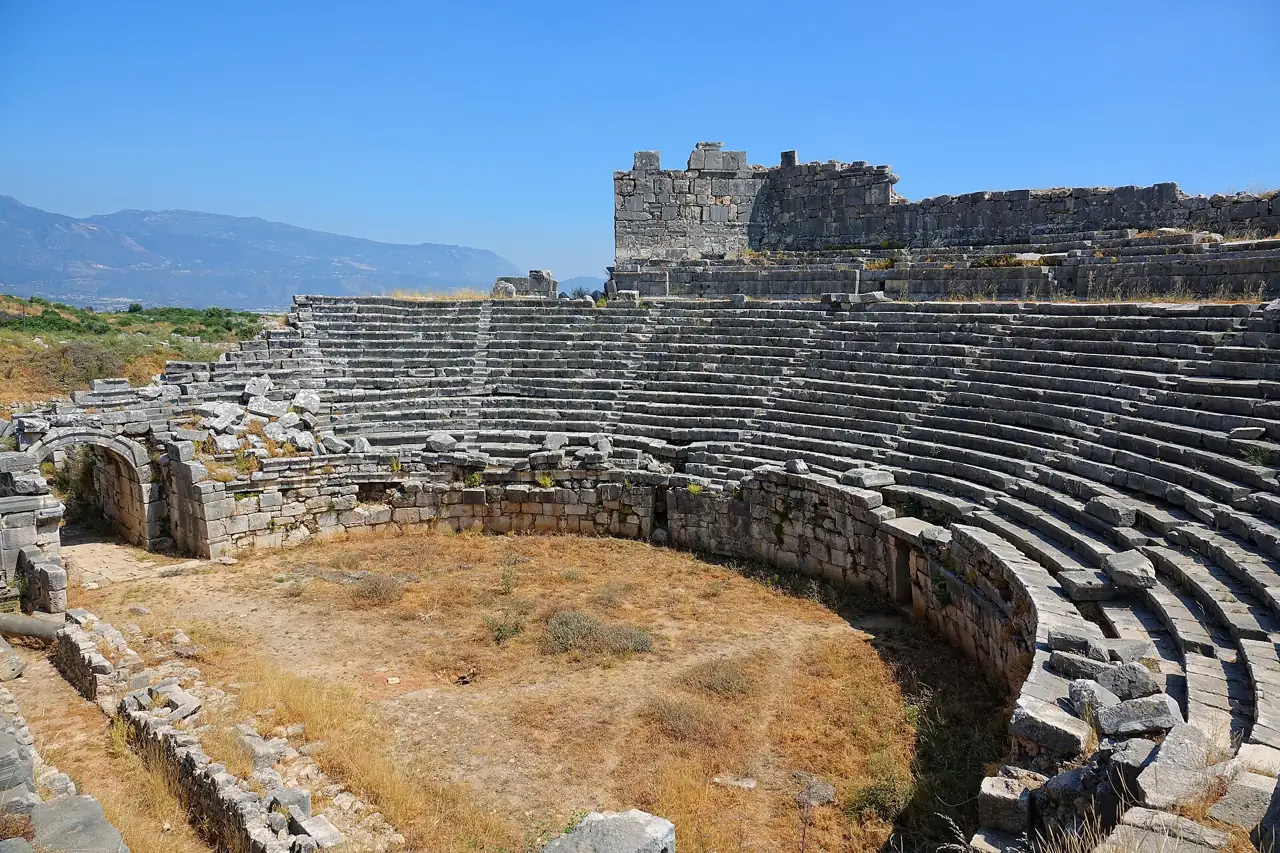
The temple-fronted rock tombs carved high into the cliff opposite Dalyan are the image everyone knows; you see them best from the river or the riverside promenade, and you cannot climb up to them. The city of Kaunos itself lies on the other bank, on the border between ancient Caria and Lycia: a theatre set into the hillside, baths, a basilica and the silted-up harbour, now a reedy lake.
Allow 1.5 to 2 hours for the site. From Dalyan you cross the river by a small rowing-boat ferry and walk about 15 minutes; most boat trips to İztuzu beach also stop here. Base: Dalyan.
Tlos
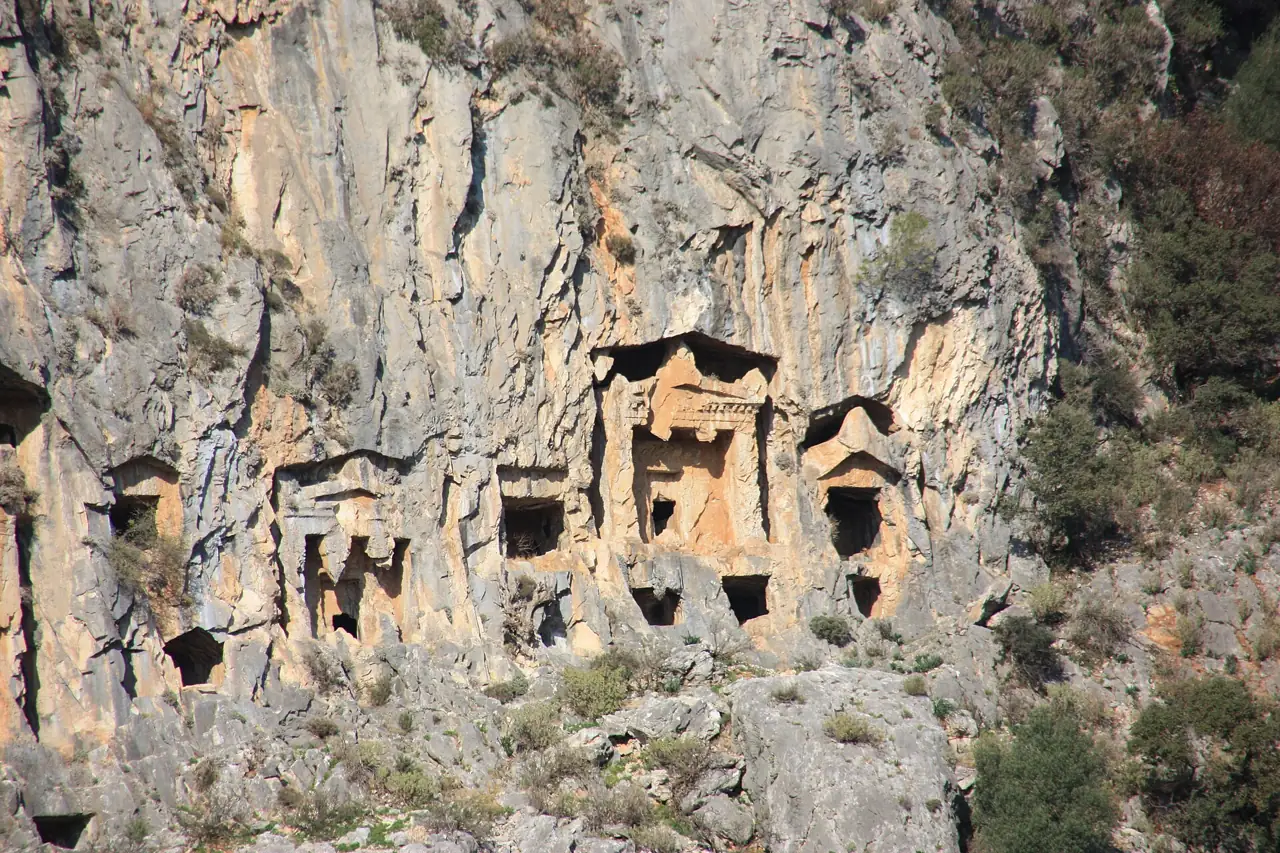
One of the oldest cities of Lycia, on a rocky spur above the Xanthos valley with the snow-capped Akdağ range behind. Rock tombs are cut into the cliff below the acropolis, among them one with a carved relief of the hero Bellerophon on his winged horse; further down are a theatre, a stadium and large baths with a view over the valley.
Allow 1.5 to 2 hours. Tlos is about 45 minutes inland from Fethiye and pairs well with Saklıkent Gorge on the same day. Base: Fethiye.
Kayaköy, the abandoned village
Not ancient, but on almost everyone's list: Kayaköy (Levissi) was a Greek Orthodox village whose people had to leave in the population exchange of 1923. Hundreds of roofless stone houses climb the hillside, with two churches and a quiet, slightly haunting atmosphere. Go in the early morning or late afternoon.
Allow 1 to 2 hours; a marked path continues over the hill to Ölüdeniz in about two hours (see our Lycian Way guide). Base: Fethiye, Hisarönü or Ölüdeniz.
Telmessos rock tombs in Fethiye
Ancient Telmessos lies under modern Fethiye, and what survives sits right in town: the Tomb of Amyntas, a temple-fronted rock tomb above the centre reached by a long flight of steps, Lycian sarcophagi standing among streets and houses, and a restored theatre by the harbour.
Allow 30 to 60 minutes, ideally in the late afternoon when the cliff catches the light. Base: Fethiye or Çalış.
The Lycian coast: Kalkan to Kemer
Xanthos and Letoon (UNESCO)
Xanthos was the leading city of ancient Lycia and, together with the nearby sanctuary of Letoon, is a UNESCO World Heritage Site. At Xanthos you see tall pillar tombs (the reliefs of the famous Harpy Tomb are copies; the originals are in the British Museum), a theatre and an inscribed pillar with the longest known text in the Lycian language. Letoon was the religious centre of the Lycian League, with three temples side by side, one of them partly re-erected; parts of the site are often under water, with frogs and turtles.
Allow about 1.5 hours for Xanthos and 1 hour for Letoon. Both are about 30 to 40 minutes from Kalkan and combine easily with Patara on one day. Base: Kalkan or Kaş.
Patara
A large site behind one of Turkey's longest beaches. The highlight is the restored bouleuterion, the assembly hall of the Lycian League, often described as one of the earliest parliament buildings; there is also a colonnaded street, a theatre and the remains of a Roman lighthouse. Tradition makes Patara the birthplace of St Nicholas.
The ticket covers both the ruins and the beach. Allow 2 to 3 hours for the ruins, or a half day with a swim. There is almost no shade among the ruins. Base: Kalkan or Kaş.
Kaş: Antiphellos
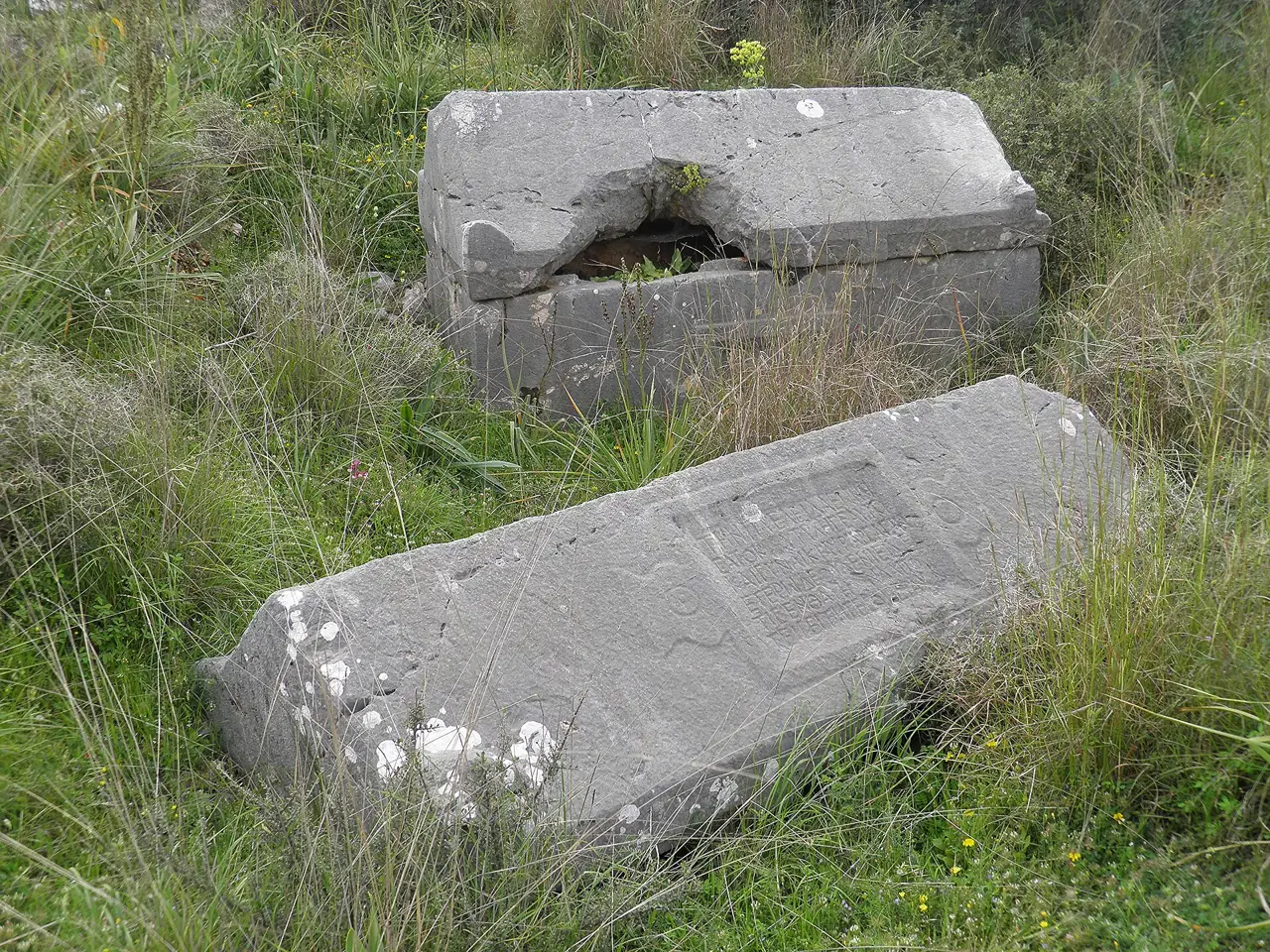
In Kaş itself you can see a small Hellenistic theatre facing the sea at the western edge of town, free and open, and a large Lycian sarcophagus standing in a street in the centre. Combine them with a sunset walk; allow 30 to 60 minutes. Base: Kaş.
Myra and the Church of St Nicholas
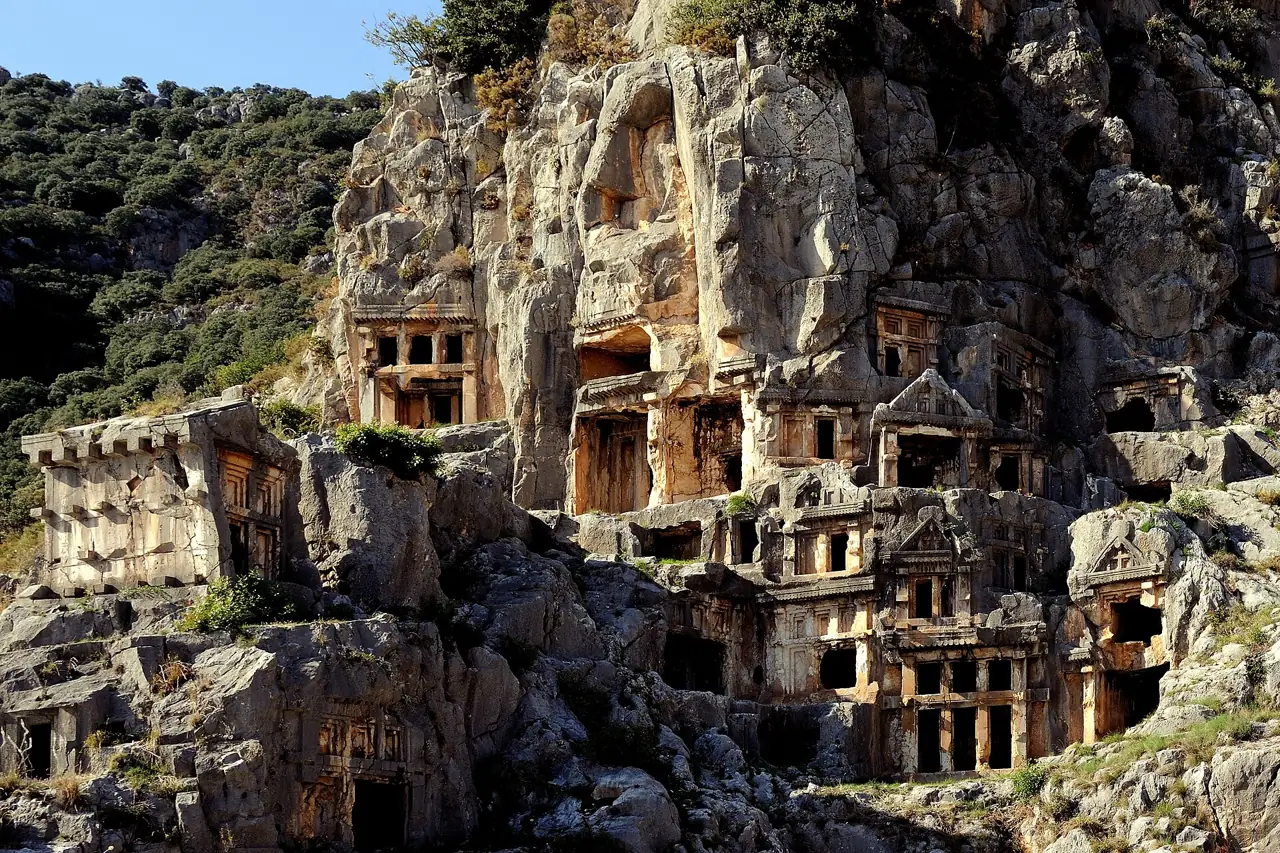
At Myra, just outside Demre, dozens of Lycian rock tombs, many carved to look like timber houses, cover a cliff above a large Roman theatre. Allow about 1 hour; the cliff faces south and gets very hot by late morning.
In the centre of Demre the Church of St Nicholas stands on the site where the bishop of Myra, the figure behind Santa Claus, is said to have served and been buried. The building is Byzantine with later rebuilding and has faded frescoes and mosaic floors; allow 45 minutes. The ancient harbour of Andriake nearby has a restored granary with a museum. Base: Demre and Kekova or Kaş.
Kekova and Simena (Kaleköy)
Off the island of Kekova the foundations of an ancient town, steps and walls lie half under water; you see this sunken city only from a boat, and swimming or snorkelling over the ruins is forbidden. Opposite, the village of Simena (Kaleköy) has a small castle with a tiny theatre cut into the rock and Lycian sarcophagi standing in the water.
Boat trips leave from Üçağız (about 2 to 3 hours) and as full-day tours from Kaş and Demre; Kaleköy has no road, you arrive by boat or on foot from Üçağız. Base: Demre and Kekova or Kaş; more in our boat trips guide.
Olympos
The ruins of Olympos are scattered along a river valley under trees, laurel and oleander: a harbour, a Roman bridge abutment, a temple gate, tombs and a Byzantine bathhouse, with the path ending at the beach. It is one of the few sites with real shade, and the ticket also gives access to the beach.
Allow 1.5 to 2 hours, plus time for a swim. In the evening the natural flames of the Chimaera (Yanartaş) are a 30-minute climb above Çıralı. Base: Olympos and Çıralı.
Phaselis
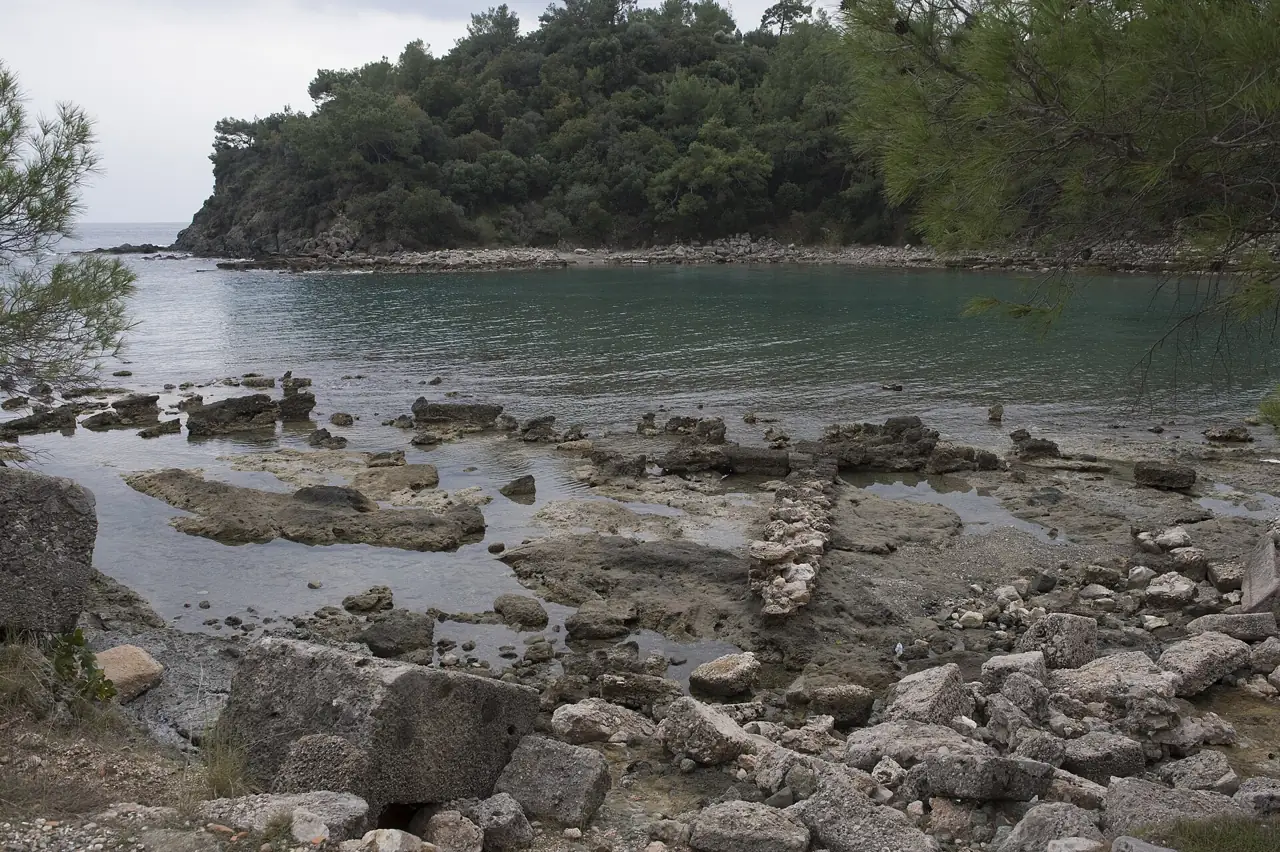
Phaselis sits on a small peninsula south of Kemer with three ancient harbours, a paved main street running between them, an aqueduct, baths and a small theatre, all under pine trees. You can swim in the old harbours, so it works as a beach and ruins morning in one.
Allow 1.5 to 2 hours plus swimming. It gets busy when boat trips and tour buses arrive around midday, so go early. About 20 minutes from Kemer and close to Tekirova. Base: Kemer.
Antalya to Alanya
Perge, Aspendos, Side and Termessos
The four best-known sites around Antalya are covered in detail, with driving times and typical prices, in our day trips guide. In short: Aspendos has the best-preserved Roman theatre anywhere (allow about 1.5 hours); Perge is a complete Roman city with a long colonnaded street and stadium (2 to 3 hours, little shade); Side has its theatre and the Temple of Apollo inside a living resort town (best at sunset, see our Side guide); Termessos is a mountain city in a national park above Antalya, with a theatre on a ledge facing the peaks (2 to 3 hours of uphill walking, good shoes needed).
Aspendos and Perge are easiest from Belek, Lara and Side; Termessos from Antalya city.
Sillyon
A hilltop city between Perge and Aspendos, still largely unexcavated, with walls, a gate and the remains of buildings on a flat-topped hill. There are usually no other visitors, no ticket office and no facilities. Parts of the hill have collapsed over the years, so stay on the paths and keep away from edges.
Allow 1 to 1.5 hours including the climb. Best for people who have already seen the big sites and want something wild. Base: Belek or Lara.
Antalya Archaeological Museum
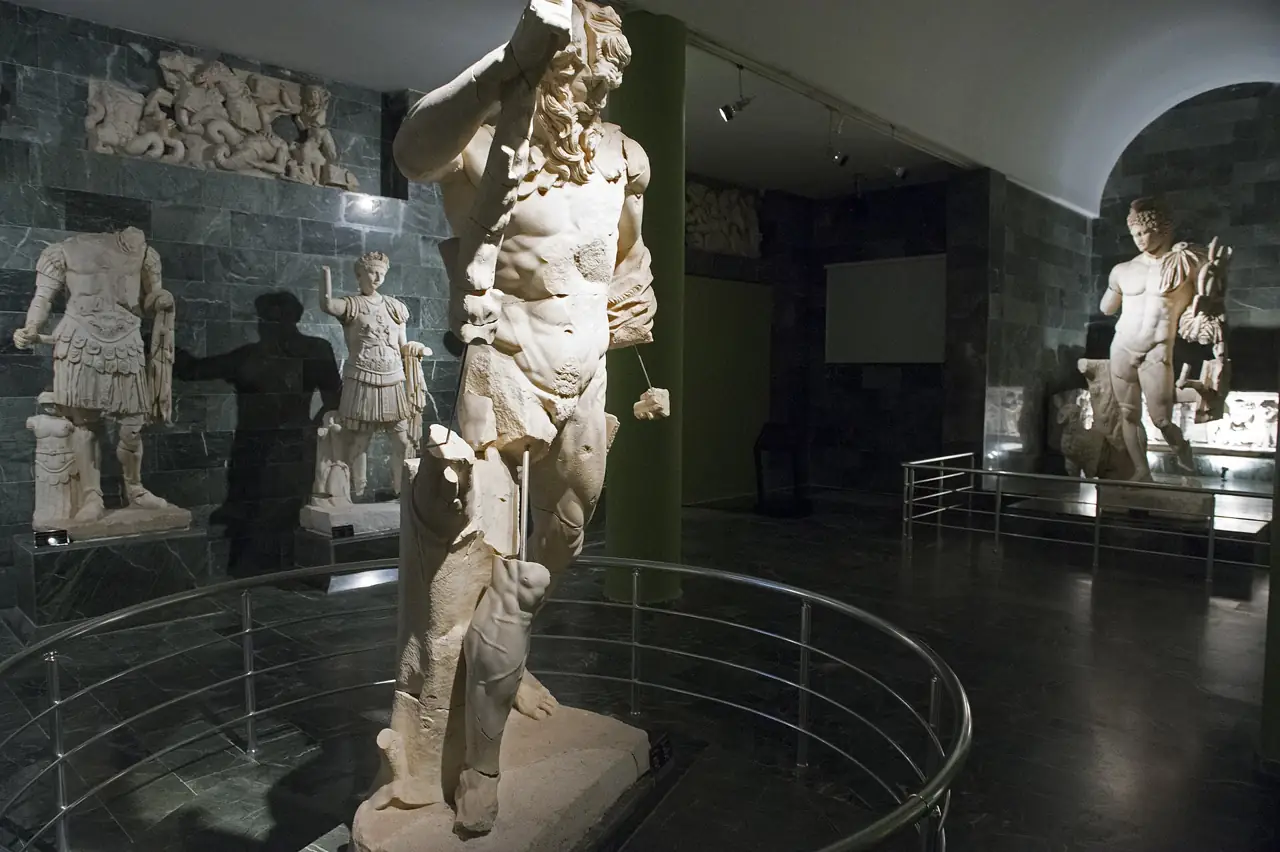
One of the best museums in Turkey and the place where many finds from Perge, Side and other sites ended up. The highlights are the halls of marble statues of gods and emperors from Perge and a fine collection of decorated sarcophagi. It is air-conditioned, which makes it the ideal midday stop on a hot day.
Allow 1.5 to 2 hours. It lies on the western side of Antalya near Konyaaltı beach. More in our Antalya city guide.
Alanya Castle
Not ancient in the classical sense, but impressive: the Seljuk walls of the 13th century wind for kilometres around the castle peninsula, down to the Red Tower by the harbour. Inside are a village, a small Byzantine church, cisterns and wide views over both bays.
Allow 2 hours, or half a day if you walk up. The cable car saves the climb. Base: Alanya.
Practical tips
Museum Pass Mediterranean
The Turkish Ministry of Culture sells a Museum Pass Mediterranean for foreign visitors that covers many state-run sites and museums in this region, including most of those on this page. It is valid for a fixed number of days and allows one visit per site. Whether it pays off depends on how many sites you will really see; with two or three it usually does not, with five or more it often does.
Prices, validity and the list of included sites change, so check the official museum pass website before you buy. Tickets and passes are sold at the site entrances; card payment is normal at state-run sites. The Müzekart is a separate one-year card for Turkish citizens; foreigners with a Turkish residence or work permit can buy a version called MüzeKart 99 online. Holiday visitors use the Museum Pass.
Heat: go early
From June to September most sites are hot by 10 am, and stone and marble reflect the heat. Arrive at opening time or come for the last two hours before closing. In midsummer plan one site per morning, not three, and spend the hot middle of the day in the sea or in a museum. Spring and autumn are the best seasons for ruins; see our weather guide.
Which sites have shade
Almost no shade: Perge, Patara, Xanthos, Letoon, Myra, Sillyon and much of Aspendos outside the theatre. Partly shaded: Kaunos and Tlos. Good shade from trees: Olympos, Phaselis and much of Termessos. If you travel in July or August, these last three are the easiest choices.
What to bring
At least one litre of water per person (many sites have a kiosk only at the entrance, some none at all), a hat, sun cream and shoes with grip: ancient paving is uneven and polished smooth. Termessos, Tlos and Sillyon involve real climbing. Do not climb on walls or tombs, and do not take stones or pottery shards; removing antiquities is a criminal offence in Turkey.
Opening hours
State-run sites have longer summer hours and shorter winter hours, and the last entry is usually some time before closing. The exact times change from year to year, so check the official museum website or ask at your hotel the day before. Free-to-visit spots such as the theatre in Kaş or the tombs in Fethiye are open at any time.
Frequently asked questions
Which ancient site should I see if I only have one day?
Near Antalya, Belek or Side: Aspendos for the theatre plus Perge, or Perge with the Antalya Museum. Near Kalkan or Kaş: Xanthos, Letoon and Patara together. Near Fethiye: Tlos with Saklıkent, or Kayaköy. See our day trips guide for driving times from the main resorts.
Can I swim at the Kekova sunken city?
No. Swimming, snorkelling and diving over the ruins at Kekova are forbidden, and you see them from the boat. Boats stop to swim in nearby bays instead, and at Simena (Kaleköy) you can walk up to the castle.
Is the Museum Pass Mediterranean worth it?
It depends on how many sites you will visit. With five or more paid sites and museums in the region it often saves money and time at ticket desks; with two or three it usually does not. Prices and the list of included sites change, so compare the current pass price with the individual tickets on the official website.
Which ancient sites are best in summer heat?
Olympos, Phaselis and Termessos have the most shade from trees, and at Olympos and Phaselis you can swim straight after. The Antalya Archaeological Museum is air-conditioned. Perge, Patara, Xanthos and Myra have almost no shade; visit them at opening time.
Can I reach the sites without a car?
Many are easy by dolmuş or a short taxi ride: Side, Phaselis, Olympos (via Çıralı or the Olympos valley), Patara, Myra and Kayaköy. Kaunos is reached by boat from Dalyan. Termessos, Tlos, Sillyon and Letoon are hard without a car or tour. See our getting around guide.