
©
Photo: Robertgombos, CC BY-SA 4.0, Wikimedia CommonsTurkish for your holiday: useful phrases and how to say them
In the resorts of the Turkish Riviera you will get by in English, and often in German or Russian too. Still, a few words of Turkish change the mood of almost every encounter: a waiter smiles, a market seller adds an extra peach, a minibus driver stops exactly where you need. This page gives you the phrases that are actually useful on holiday, from hello and thank you to the bill, numbers and an emergency, with a simple respelling so you can say them. Turkish is written the way it sounds, so six reading rules take you a long way. Stressed syllables are in capitals.
Reading Turkish: six rules
ç and ş: ch and sh
ç sounds like the ch in church, ş like the sh in ship. So çay (tea) is "chai" and beş (five) is "besh". Once you know these two, many signs and menus suddenly become readable.
c is always j
The Turkish c is never a k or an s sound: it is the j in jam. Cami (mosque) is "jah-MEE" and eczane (pharmacy) is "ej-zah-NEH". This is the letter visitors get wrong most often.
ğ is silent
The soft g, ğ, is not pronounced on its own: it simply lengthens the vowel before it. Dağ (mountain) sounds like "daa", Muğla like "MOO-lah" and sağ ol (thanks) like "saa ol".
ı without a dot
The dotless ı is a short, relaxed sound a bit like the a in about; we write it "uh". It is a separate letter from the dotted i ("ee"). Kapalı (closed) is "kah-pah-LUH", while iki (two) is "ee-KEE".
ö and ü
These are the same sounds as in German. For ü, say "ee" and round your lips as if to whistle; we write it "ew". For ö, say "e" with rounded lips, close to the vowel in the British "fur"; we write it "ur". Güle güle (goodbye, said by the person staying) is "gew-leh gew-leh".
Every letter counts, stress mostly at the end
Every letter is pronounced, including a final e and both halves of double letters: elli (fifty) is "el-LEE". The r is lightly tapped and h is always heard, as in merhaba. In most words the stress falls on the last syllable, but there are many exceptions, especially in place names: Ankara is "AN-kah-rah". Don't worry too much; people will understand you.
Greetings and courtesy
Merhaba
Hello, at any time of day: "MEHR-hah-bah". When you leave a shop or a table, say hoşça kalın ("hosh-chah kah-luhn", goodbye); the person staying answers güle güle.
Günaydın, iyi akşamlar
Good morning is günaydın, "gewn-eye-DUHN". Good evening is iyi akşamlar, "ee-YEE ahk-shahm-LAHR", and you can use it as a goodbye after dark too.
Teşekkür ederim, teşekkürler, sağ olun
Thank you: teşekkür ederim, "teh-shek-KEWR eh-deh-rim". The shorter teşekkürler ("teh-shek-kewr-LEHR") is fine everywhere. Locals often say sağ olun, "saa oh-loon", literally "be healthy"; it is warm and easy to say.
Lütfen
Please: "LEWT-fen". Put it after what you want: bir çay, lütfen ("beer chai LEWT-fen", a tea, please).
Rica ederim
You're welcome, the polite answer to a thank you: "ree-JAH eh-deh-rim". You will hear it a lot, so it is good to recognise it.
Kolay gelsin
"koh-LIGH gel-SIN", literally "may it come easy". Turks say it to anyone at work: a shopkeeper, a cleaner, someone fixing a boat. It is a small greeting that shows you notice their effort, and it almost always gets a smile and a sağ ol back.
Afiyet olsun
"ah-fee-YET ol-SOON", the Turkish bon appétit. Waiters say it when they bring your food, and you can say it to people at the next table or to your hosts.
Eline sağlık
"eh-lee-NEH saa-LUHK", literally "health to your hand". Say it to whoever cooked your meal: a host, a gözleme maker at the market, the cook in a small restaurant. The usual reply is afiyet olsun. Of all the phrases here, these two win the most hearts, because they come from the everyday life of Turkish homes rather than from a phrasebook.
In restaurants and markets
Hesap, lütfen
The bill, please: "heh-SAHP LEWT-fen". Waiters rarely bring the bill unasked; catching their eye and miming writing works too. More on meals, tipping and paying in our food guide.
Bu ne kadar?
How much is this? "boo neh kah-DAHR". If the answer comes too fast, hand over your phone's calculator or a piece of paper; numbers are below.
Çok güzel
Very nice, delicious, beautiful: "chok gew-ZEL". It works for food, a view, a carpet or a sunset. Çok (very) alone is a useful word too.
Su, maden suyu
Su ("soo") is water; bir şişe su ("beer shee-SHEH soo") is a bottle of water. Maden suyu ("mah-den soo-yoo") is sparkling mineral water, often sold in small glass bottles.
Çay
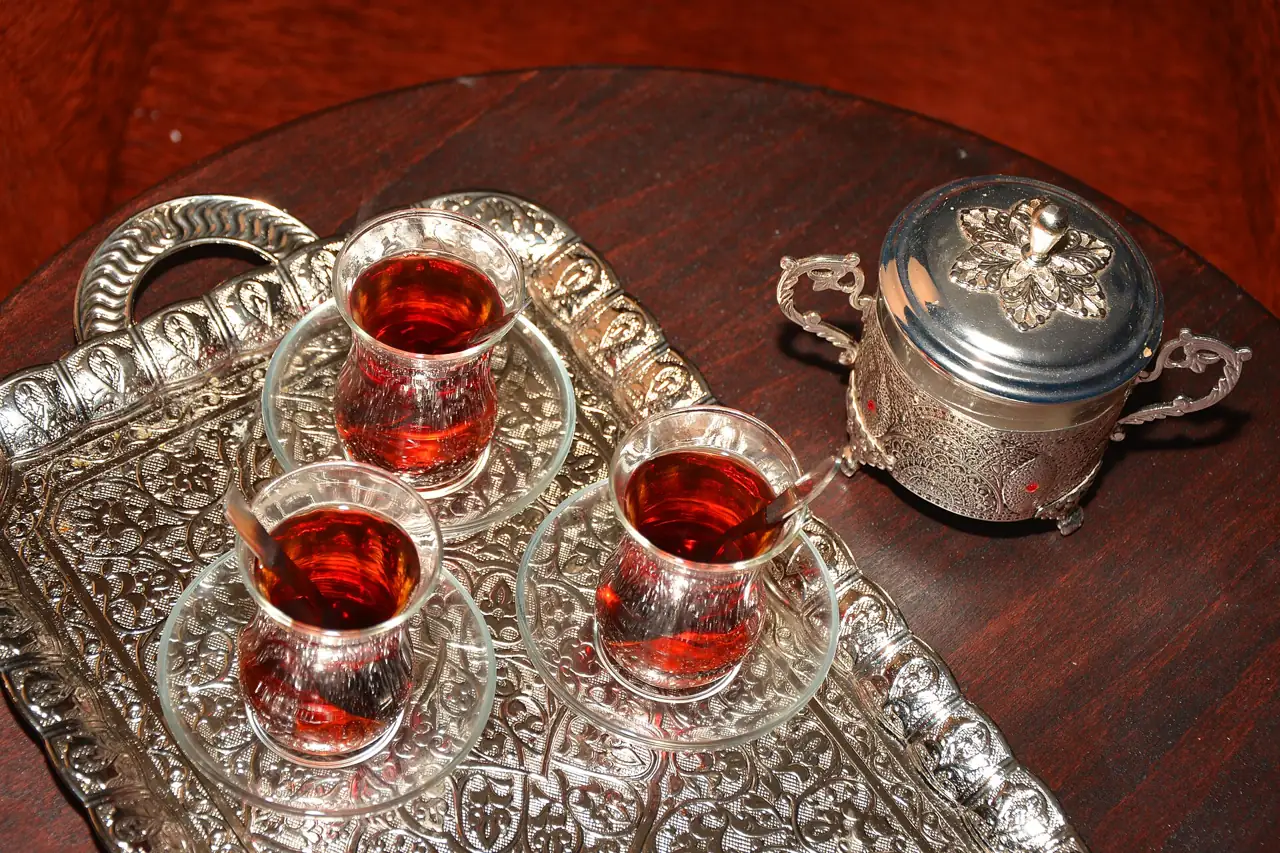
Tea: "chai". Tea comes in small tulip-shaped glasses, black and strong, with sugar cubes on the side. Shopkeepers often offer one while you browse; you can accept with teşekkürler without feeling you have to buy.
Acısız
Not spicy: "ah-juh-SUHZ". Acı var mı? ("ah-JUH var muh") means "is it spicy?". Most dishes are mild, but some kebabs, peppers and dips are not.
Vejetaryenim, et yemiyorum
I'm vegetarian: vejetaryenim, "veh-zheh-tar-yen-eem" (the Turkish j is like the s in pleasure). Et yemiyorum ("et YEH-mee-yoh-room") means "I don't eat meat". Ask about soups and rice, which are sometimes made with meat stock.
Alerjim var: fıstık
I have an allergy: alerjim var, "ah-ler-zheem var". Fıstık ("fuhs-TUHK") is used for both pistachio and peanut; peanut is specifically yer fıstığı ("yer fuhs-tuh-uh"). With a serious allergy, carry a card written in Turkish and check with the staff each time; our health and safety guide has more. For bazaars and what to buy, see shopping.
Directions and emergencies
... nerede?
Where is ...? Add nerede ("neh-reh-deh") after the place: plaj nerede? ("plahzh neh-reh-deh", where is the beach?). Pointing and a map on your phone do the rest.
Tuvalet nerede?
Where is the toilet? "too-vah-LET neh-reh-deh". On doors, Bay or Erkek means men and Bayan or Kadın means women.
Eczane
Pharmacy: "ej-zah-NEH", with a red E sign outside. At night and on Sundays one pharmacy per district stays open: the nöbetçi eczane ("nur-bet-chee ej-zah-neh", duty pharmacy), listed on every pharmacy's door.
Yardım edin! İmdat!
Help! Yardım edin is "yar-DUHM eh-din"; imdat ("eem-DAHT") is the shouted cry for help in an emergency.
112
112 is the single emergency number in Turkey for ambulance, police and fire. Say where you are as precisely as you can (hotel name, town, a landmark); operators can often find someone who speaks English. More in our health and safety guide.
İnecek var!
On a dolmuş (shared minibus) there are often no fixed stops. Call out inecek var ("ee-neh-JEK var", someone is getting off) and the driver will pull over. Müsait bir yerde ("mew-sah-eet beer yer-deh") means "wherever convenient".
Sağa, sola, düz
Right, left, straight on: sağa ("saa-ah"), sola ("soh-lah"), düz ("dewz"). Useful in a taxi, and you will hear them when you ask the way.
Anlamıyorum. İngilizce biliyor musunuz?
I don't understand: "ahn-LAH-muh-yoh-room". Do you speak English?: İngilizce biliyor musunuz? ("een-ghee-leez-jeh bee-lee-yor moo-soo-nooz"). In the resorts the answer is usually yes.
Numbers and bargaining
One to ten
bir ("beer") 1, iki ("ee-KEE") 2, üç ("ewch") 3, dört ("durt") 4, beş ("besh") 5, altı ("ahl-TUH") 6, yedi ("yeh-DEE") 7, sekiz ("seh-KEEZ") 8, dokuz ("doh-KOOZ") 9, on ("on") 10. Bir also means "a": bir çay is one tea.
Bigger numbers
yirmi ("yeer-MEE") 20, elli ("el-LEE") 50, yüz ("yewz") 100, bin ("bin") 1,000. They combine simply: iki yüz elli is 250, on bin is 10,000. Don't mix up bir (one) and bin (a thousand).
Çok pahalı
Too expensive: "chok pah-hah-LUH". Say it with a smile, not as an accusation.
Son fiyat?
Final price? "son fee-YAHT". Bargaining is normal for carpets, leather, jewellery and souvenirs in bazaar-style shops, much less so at the weekly markets where produce prices are usually set, and not at all in supermarkets, pharmacies or anywhere with printed price tags. Ask politely, make a fair offer and be ready to walk away kindly. More in our shopping guide.
İndirim var mı?
Is there a discount? "een-dee-REEM var muh". A softer way to start than naming a lower price, and it is fine to ask in small shops.
Kart geçiyor mu? Nakit
Do you take cards? Kart geçiyor mu? ("kart geh-CHEE-yor moo"). Nakit ("nah-KEET") is cash. Paying in Turkish lira rather than euros usually gets you the fairer price; see our money guide.
Frequently asked questions
Do people speak English on the Turkish Riviera?
In hotels, resort restaurants and shops, most staff speak some English, and many speak German or Russian too. In villages, at weekly markets and on local minibuses you will meet fewer English speakers. A few Turkish words, a smile and a translation app cover almost everything.
How do you say thank you in Turkish?
Teşekkür ederim ("teh-shek-KEWR eh-deh-rim") is the full form, teşekkürler ("teh-shek-kewr-LEHR") the shorter one. Many locals simply say sağ ol or, more politely, sağ olun ("saa oh-loon").
Is Turkish hard to pronounce?
Less than it looks. Turkish is spelled the way it sounds and every letter is pronounced. Learn the six rules at the top of this page (ç, ş, c, ğ, ı, ö/ü) and you can read menus, signs and place names.
What does "kolay gelsin" mean?
Literally "may it come easy". It is said to anyone who is working: a shopkeeper, a waiter, a cleaner. It is friendly, not formal, and locals appreciate hearing it from visitors. The usual answer is sağ ol.
Should I bargain in Turkey?
Only where it is the custom: carpets, leather, jewellery and souvenirs in bazaar-style shops. Not in supermarkets, pharmacies, restaurants or where prices are printed. Son fiyat? (final price?) asked politely is enough. See our shopping guide.